TEXTS
Milano Attraverso
La sezione architettonica è uno strumento di rappresentazione molto interessante perché permette di visualizzare il processo progettuale, visualizzare la struttura architettonica, le connessioni tra le parti, tra l’interno e l’esterno. Come scriveva Le Corbusier nel suo testo Vers une architecture del 1923 la sezione rivela l’essenza interna di un edificio, superando la mera estetica della facciata, la sua importanza è paragonabile a un ‘taglio anatomico’ che svela la struttura portante, gli isolamenti e le soluzioni costruttive.
Due secoli prima Canaletto e Antonio Visentini, lavorando all’album di vedute di Venezia Prospectus Magni Canalis del 1745, ricostruiscono un percorso visivo attraverso la città, percorrono una linea di sezione a scala urbana raccontando la città, la sua struttura, il rapporto tra le parti.
Fotografare la città porta con sé il rischio di raccontare la mera estetica della facciata, attraverso i suoi edifici più rappresentativi o raccontare la città attraverso edifici, forme visive a noi ricorrenti, famigliari, radicati nel nostro immaginario. Individuare una linea di sezione, un percorso di attraversamento della città è il primo atto di esplorazione della città.
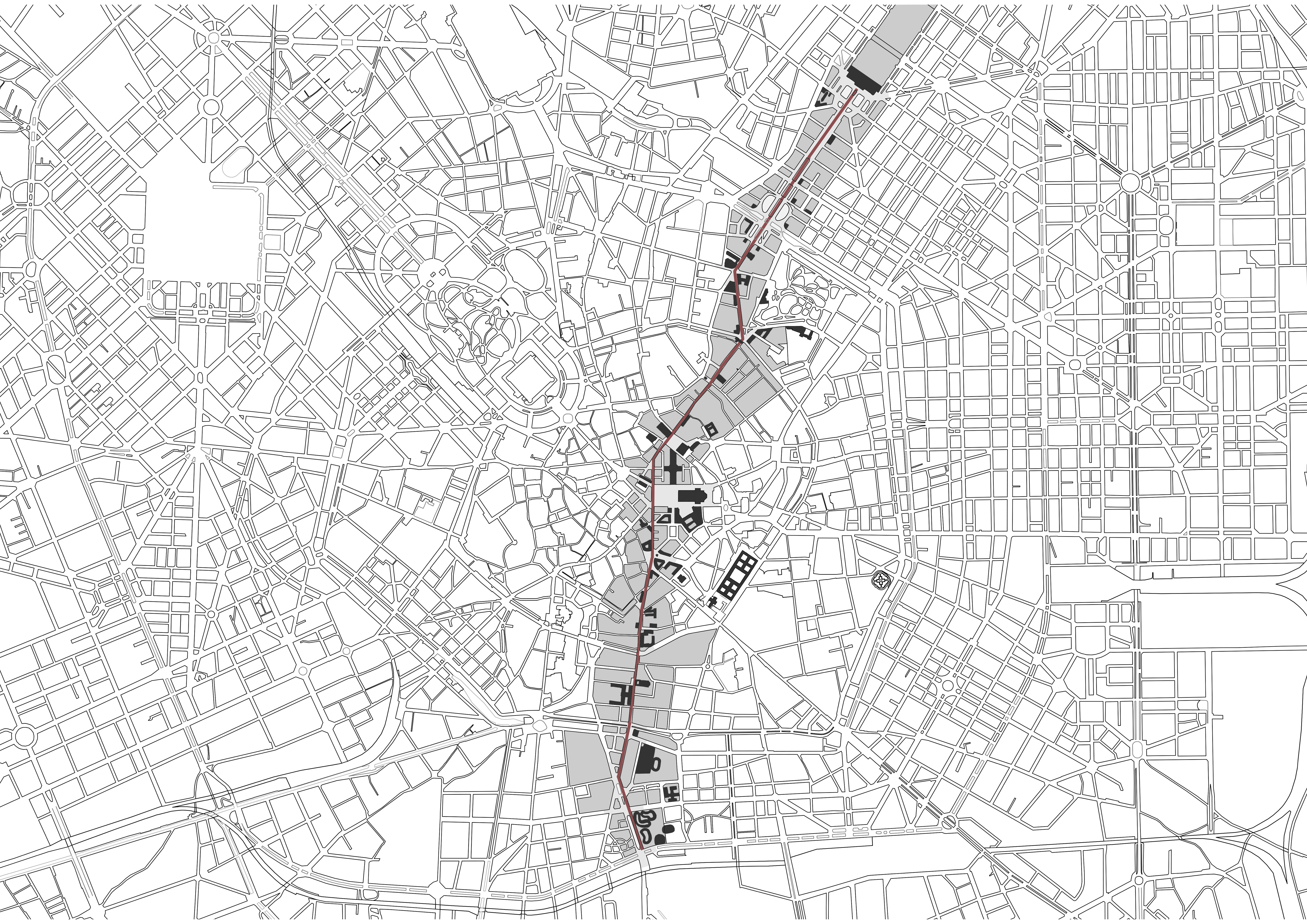
Partendo da questi presupposti ho iniziato un’analisi storica della città, la sua iconografia e una ricostruzione delle soglie storiche attraverso la sovrapposizione delle mappe dal 1500 ad oggi individuando un percorso fisico, una linea di sezione, che raccontasse la struttura della città.
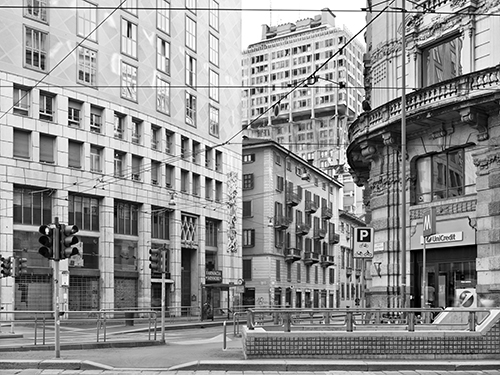
Da Porta Ludovica, nuovo ingresso alla città voluto da Ludovico il Moro per agevolare i pellegrini verso la chiesa di San Celso, percorrendo corso Italia, tracciato completato solo all’inizio del Novecento con l’apertura dell’ultimo tratto verso piazza Missori, via Mazzini, si raggiunge piazza Duomo per proseguire in via Manzoni ridisegnato con il Piano del Pinchetti nel ‘800, via Turati si attraversa non solo la città ma la anche la sua storia urbana e architettonica.
La scelta fotografica è stata quella del racconto dello spazio urbano, delle relazioni che gli edifici costruiscono tra loro, quando la luce diffusa della prima mattina illumina la città senza la drammaticità delle ombre e il silenzio, anche visivo, amplifica la percezione del paesaggio e la sua comprensione, inserendosi in un preciso linguaggio visivo che dall’Ottocento arriva alla contemporaneità.
Marco Introini, in Milano attraverso, 2013-2025, Milano 2025
Milano Attraverso
The architectural section is a very interesting representational tool because it allows one to visualize the design process, to see the architectural structure, the connections between the parts, between inside and outside. It is, as Le Corbusier wrote in his 1923 text Vers une architecture, the section that reveals the inner essence of a building, going beyond the mere aesthetics of the façade; its importance is comparable to an “anatomical cut” that exposes the load-bearing structure, the insulation, and the construction solutions.
Two centuries earlier, Canaletto and Antonio Visentini, working on the album of views of Venice Prospectus Magni Canalis of 1745, reconstructed a visual path through the city: they traced a sectional line at an urban scale, narrating the city, its structure, and the relationships between its parts.
Photographing the city carries with it the risk of telling only the mere aesthetics of the façade, through its most representative buildings, or of narrating the city through buildings and visual forms that are recurring, familiar to us, rooted in our imagination. Identifying a sectional line, a path that crosses the city, is the first act of exploring the city.
Starting from these premises, I began a historical analysis of the city, its iconography, and a reconstruction of historical thresholds through the superimposition of maps from the 1500s to today, identifying a physical route, a sectional line, that would tell the story of the city’s structure. From Porta Ludovica, the new gateway to the city commissioned by Ludovico il Moro to ease pilgrims’ access to the church of San Celso, proceeding along Corso Italia—a route completed only at the beginning of the twentieth century with the opening of the last stretch towards Piazza Missori—then via Mazzini to reach Piazza Duomo and continue along via Manzoni, redesigned by Pinchetti’s plan in the nineteenth century, and via Turati, one crosses not only the city but also its urban and architectural history.
The photographic choice was to narrate the urban space, the relationships that buildings construct with one another, at the moment when the diffuse light of early morning illuminates the city without the drama of shadows and the silence, even visual, amplifies the perception of the landscape and its understanding, placing itself within a precise visual language that stretches from the nineteenth century to the contemporary world.
Marco Introini, in Milano Attraverso, 2013–2025, Milan 2025
La sezione architettonica è uno strumento di rappresentazione molto interessante perché permette di visualizzare il processo progettuale, visualizzare la struttura architettonica, le connessioni tra le parti, tra l’interno e l’esterno. Come scriveva Le Corbusier nel suo testo Vers une architecture del 1923 la sezione rivela l’essenza interna di un edificio, superando la mera estetica della facciata, la sua importanza è paragonabile a un ‘taglio anatomico’ che svela la struttura portante, gli isolamenti e le soluzioni costruttive.
Due secoli prima Canaletto e Antonio Visentini, lavorando all’album di vedute di Venezia Prospectus Magni Canalis del 1745, ricostruiscono un percorso visivo attraverso la città, percorrono una linea di sezione a scala urbana raccontando la città, la sua struttura, il rapporto tra le parti.
Fotografare la città porta con sé il rischio di raccontare la mera estetica della facciata, attraverso i suoi edifici più rappresentativi o raccontare la città attraverso edifici, forme visive a noi ricorrenti, famigliari, radicati nel nostro immaginario. Individuare una linea di sezione, un percorso di attraversamento della città è il primo atto di esplorazione della città.
Partendo da questi presupposti ho iniziato un’analisi storica della città, la sua iconografia e una ricostruzione delle soglie storiche attraverso la sovrapposizione delle mappe dal 1500 ad oggi individuando un percorso fisico, una linea di sezione, che raccontasse la struttura della città.
Da Porta Ludovica, nuovo ingresso alla città voluto da Ludovico il Moro per agevolare i pellegrini verso la chiesa di San Celso, percorrendo corso Italia, tracciato completato solo all’inizio del Novecento con l’apertura dell’ultimo tratto verso piazza Missori, via Mazzini, si raggiunge piazza Duomo per proseguire in via Manzoni ridisegnato con il Piano del Pinchetti nel ‘800, via Turati si attraversa non solo la città ma la anche la sua storia urbana e architettonica.
La scelta fotografica è stata quella del racconto dello spazio urbano, delle relazioni che gli edifici costruiscono tra loro, quando la luce diffusa della prima mattina illumina la città senza la drammaticità delle ombre e il silenzio, anche visivo, amplifica la percezione del paesaggio e la sua comprensione, inserendosi in un preciso linguaggio visivo che dall’Ottocento arriva alla contemporaneità.
Marco Introini, in Milano attraverso, 2013-2025, Milano 2025
Milano Attraverso
The architectural section is a very interesting representational tool because it allows one to visualize the design process, to see the architectural structure, the connections between the parts, between inside and outside. It is, as Le Corbusier wrote in his 1923 text Vers une architecture, the section that reveals the inner essence of a building, going beyond the mere aesthetics of the façade; its importance is comparable to an “anatomical cut” that exposes the load-bearing structure, the insulation, and the construction solutions.
Two centuries earlier, Canaletto and Antonio Visentini, working on the album of views of Venice Prospectus Magni Canalis of 1745, reconstructed a visual path through the city: they traced a sectional line at an urban scale, narrating the city, its structure, and the relationships between its parts.
Photographing the city carries with it the risk of telling only the mere aesthetics of the façade, through its most representative buildings, or of narrating the city through buildings and visual forms that are recurring, familiar to us, rooted in our imagination. Identifying a sectional line, a path that crosses the city, is the first act of exploring the city.
Starting from these premises, I began a historical analysis of the city, its iconography, and a reconstruction of historical thresholds through the superimposition of maps from the 1500s to today, identifying a physical route, a sectional line, that would tell the story of the city’s structure. From Porta Ludovica, the new gateway to the city commissioned by Ludovico il Moro to ease pilgrims’ access to the church of San Celso, proceeding along Corso Italia—a route completed only at the beginning of the twentieth century with the opening of the last stretch towards Piazza Missori—then via Mazzini to reach Piazza Duomo and continue along via Manzoni, redesigned by Pinchetti’s plan in the nineteenth century, and via Turati, one crosses not only the city but also its urban and architectural history.
The photographic choice was to narrate the urban space, the relationships that buildings construct with one another, at the moment when the diffuse light of early morning illuminates the city without the drama of shadows and the silence, even visual, amplifies the perception of the landscape and its understanding, placing itself within a precise visual language that stretches from the nineteenth century to the contemporary world.
Marco Introini, in Milano Attraverso, 2013–2025, Milan 2025
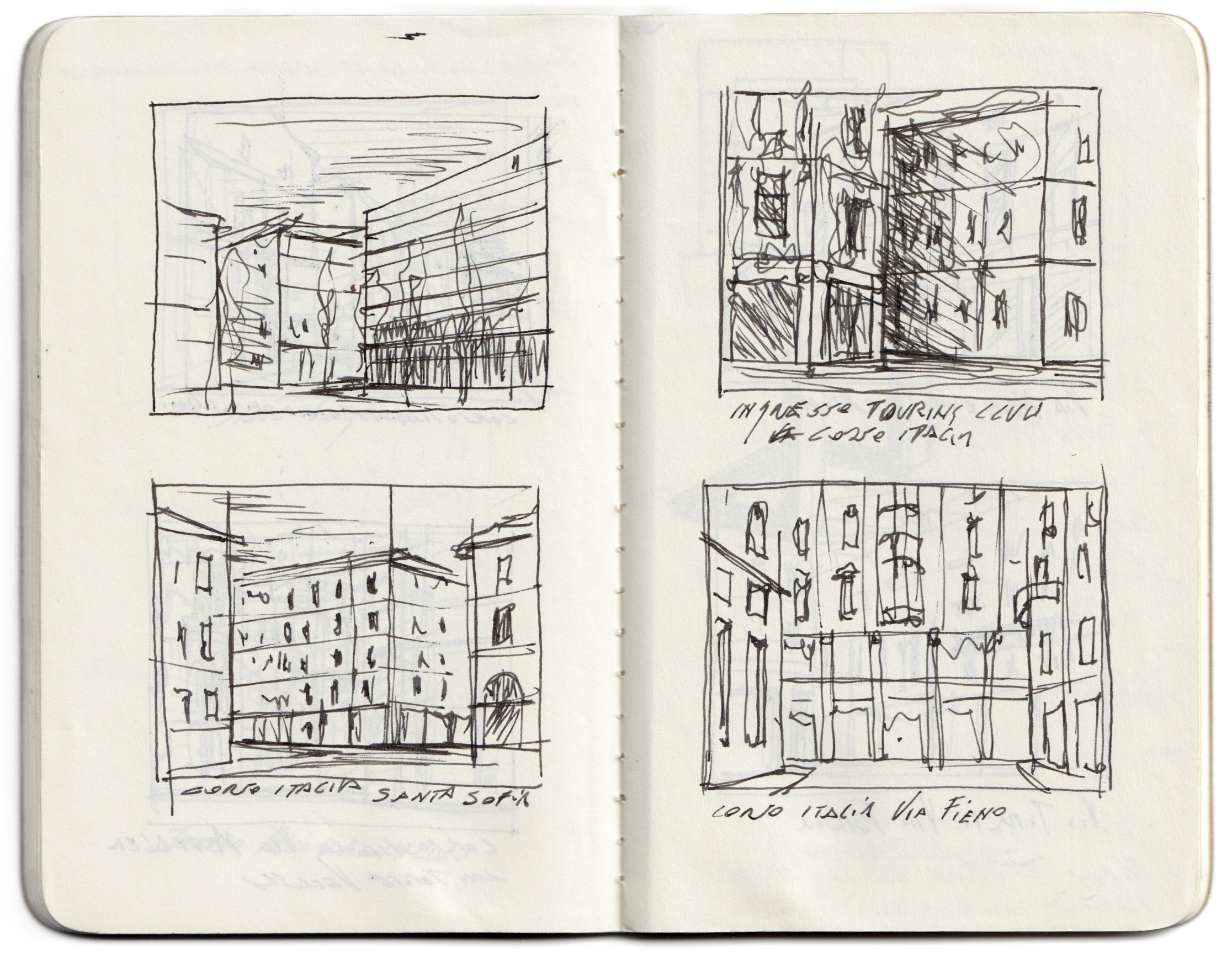
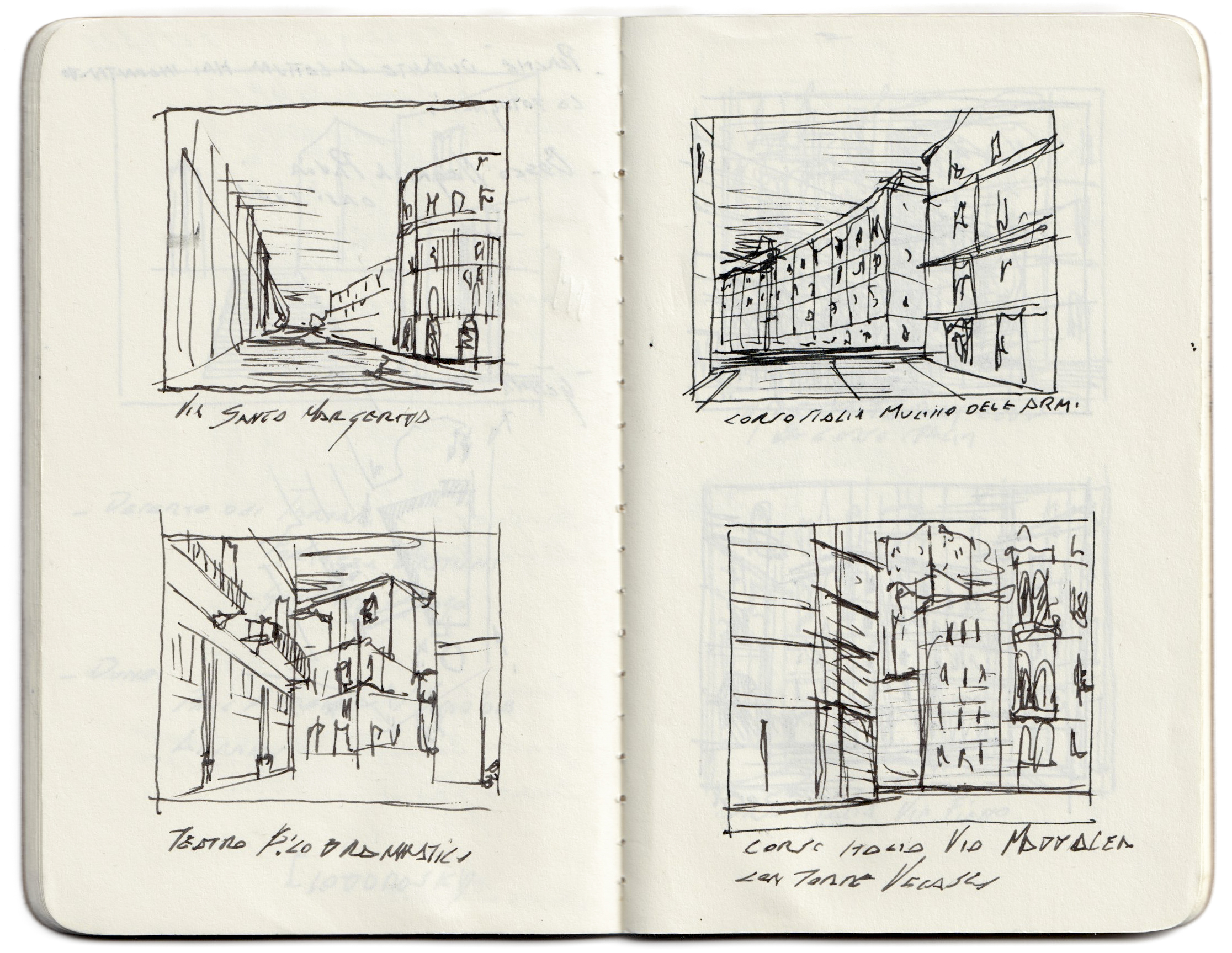
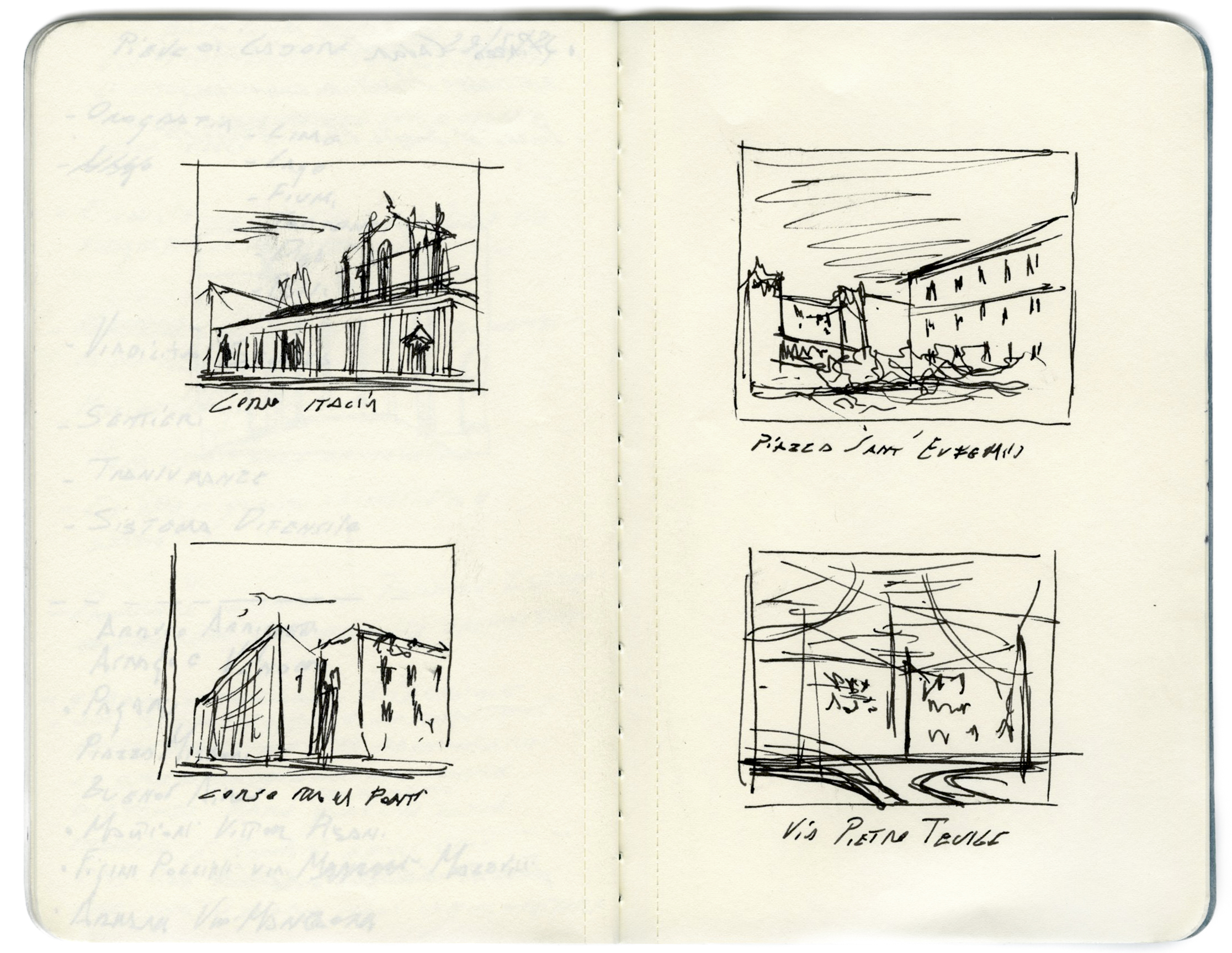
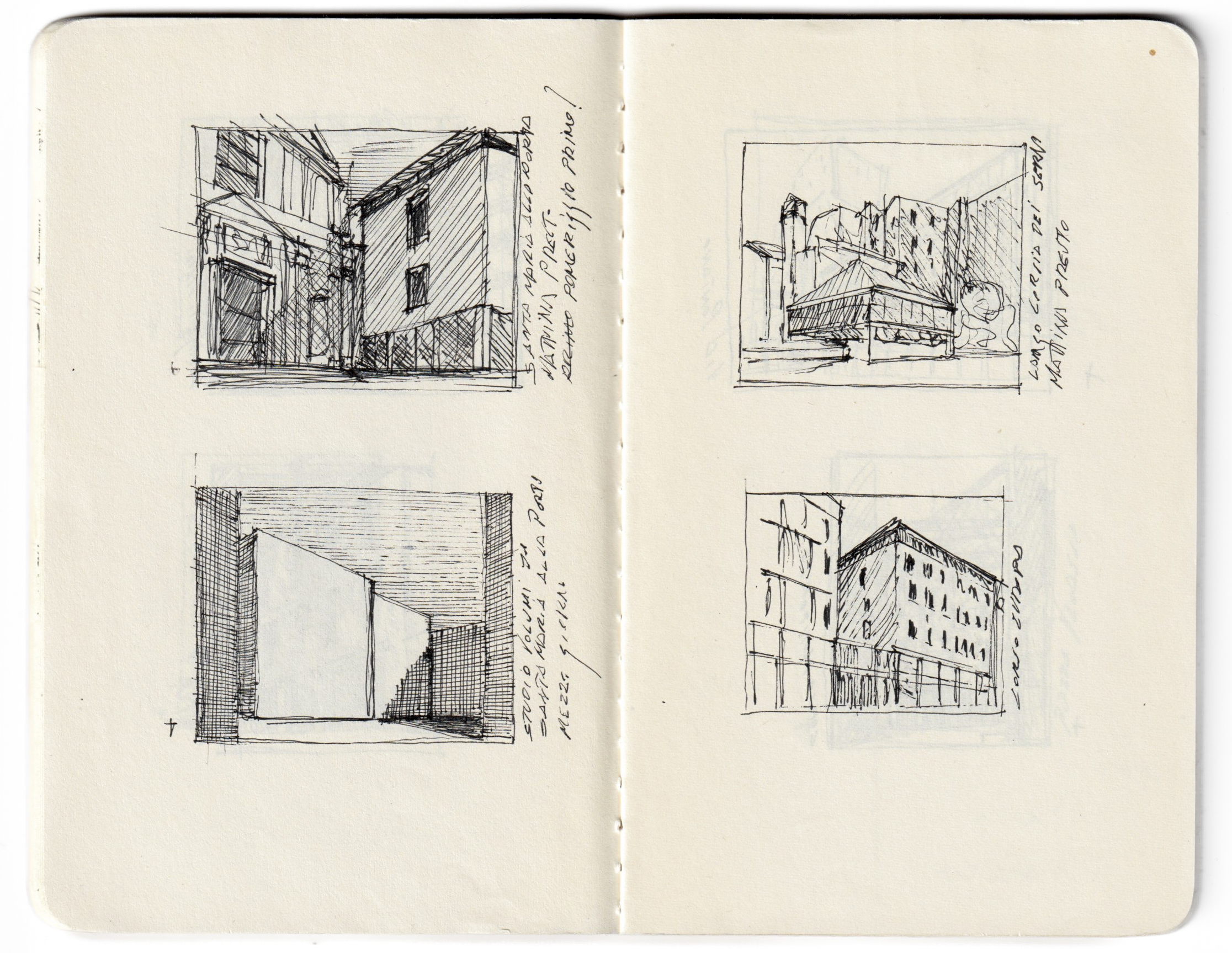
Some sketches before and
the working map for the exploration
the working map for the exploration
to photo work