TEXTS
AMENDOLEA
Architettura è molte cose insieme. È questa “non specificità”, l’aspetto cosiddetto umanistico che ne fa, particolarmente oggi, uno strumento di connessione tra la complessità dell’evoluzione sociale (delle comunità e individuale) e la trasformazione dello spazio sul piano intimo e collettivo, pubblico e privato, infine nella conciliazione tra natura e artificio.
Presupposto di questo approccio all’architettura è l’osservazione, la capacità di “volgere lo sguardo”.
Marco Introini interpreta l’atto e l’arte di vedere in una sapiente sintesi fotografica di conoscenza e percezione che combina tutti le “necessità” e gli aspetti del progettare.
La condivisione di pensiero tra me e Marco ha trasformato il nostro rapporto professionale in un’amicizia/viaggio continuo in cui le esperienze differenti, lo sguardo sull’ambiente naturale e sul costruito, sull’architettura-edificio, sull’architettura-città e sull’architettura-territorio è parte fondamentale del processo creativo.
L’esplorazione della fiumara Amendolea è una delle tappe del nostro viaggio mediterraneo.
--------------------------------
“L’acqua della vicina distesa marina – là dove Tirreno e Ionio si abbracciano e si confondono generando incontri, arrivi, leggende, miti, mostri, sirene – le acque delle fiumare e dei torrenti – dove abitavano le Nereidi e le Naiadi, che scendono ora furiose ora lente dalle montagne vicine – e le correnti e i venti, che si formano e giocano tra terra e cielo, creano quei cirri e quelle pecorelle ora stabili ora volanti che sembrano volere distrarti, farti perdere e smarrire, incantato, indeciso se guardare il mare, le vallate, le colline, i monti, le casupole o le campagne, che solo di rado diventano orti e ancora si offrono con le piante di ulivi secolari, di uva, di fichi e più in basso di agrumi.”
L’ha scritto Vito Teti, antropologo calabrese, grande maestro della scrittura che, insieme al racconto dei luoghi, genera immagini ed emozioni.
“Terra di bellezze e di rovine”, di eccessi e di grandi contrasti geografici, climatici, sociali. Di pieni e di vuoti. Di suono e di silenzio. Il basso e l’alto, il sottoterra e il cielo. Le luci e le ombre. Le acque dei fiumi e dello Stretto, le cime dei monti e gli sprofondi della natura: tutti qui concentrati”.
Ogni scatto di Marco Introini pare contrappunto alle parole di Vito: l’ossimoro di “ascoltare” il silenzio dell’acqua, muta nello svolgersi dell’estate; l’eco del suo suono gonfio e vorace, che sorge dall’arido letto: il tracciato delle parole, cariche della memoria “degli sprofondi della natura”.
Le fotografie raccontano un’acqua invisibile e potente che disegna i paesaggi delle tre linee, di crinale, di costa e di piana.
L’Amendolea è una sintesi di Mediterraneo, lambisce il mare e la sua costa, scende dall’Aspromonte, corre nella pianura per poco meno di 40 chilometri, una distanza che prende più di dieci ore di cammino.
Marco ha camminato quattro giorni per risalire l’argine, quattro tramonti e quattro albe, quattro volte mezzogiorno, addomesticando, in ogni singolo scatto, i colori appannati dal caldo del Sud estivo e l’intensa densità dell’aria.
Ha un passato di grande fiume l’Amendolea, premessa per il sorgere d’insediamenti urbani, paesi e borghi.
Nel tempo, il territorio si è trasformato, segnato - come molta parte della Calabria - da terremoti e alluvioni: il fiume è diventato fiumara che dall’Aspromonte si innesta nello Ionio con la grazia delle acque che si confondono tra fluviali e marine.
La sommità della montagna, la pianura, la costa: l’Amendolea lambisce le tre dimensioni, le accarezza e, talvolta, le minaccia.
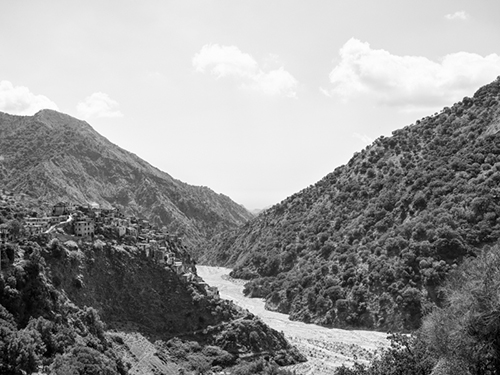
Ghiaia e massi giacciono sul suo letto scoperto: il bianco pietrisco rivela l’assenza dell’acqua e scolpisce uno scenario metafisico, che nella fotografia diventa astrazione assoluta.
La luce modifica l’acqua e lo sguardo si modula sul cambiamento: quando l’acqua viene raggiunta dalla luce che penetra attraverso le gole montane, nell’oscillazione tra l’azzurro del cielo, il verde della montagna, il rosso della terra che si scompone e, appunto, il bianco delle pietre.
Registri visivi che il bianco e nero della fotografia scalpellano, modellano, rendono unici.
Insieme a Marco, abbiamo cominciato a esplorare l’acqua per comprenderne il comportamento, il suo crescere e il suo ritrarsi, l’arroganza e la sua insidiosa timidezza, la sua anima pericolosamente trascurata.
Il “viaggio” con Marco è cominciato quattro anni fa, con una ricerca fotografica sulle quattro Repubbliche marinare, le città d’acqua, Amalfi, Pisa, Venezia e Genova.
Un’esplorazione di confine, come sempre è per l’acqua: il mare visto dal lato della storia, mare conquistato, perso, riconquistato e di nuovo perso ... il continuo movimento dell’acqua che sembra riflettere la ciclica ripetizione degli eventi, natura e artificio in un rimando continuo nel Tempo.
Nella fiumara Amendolea si condensa l’essenza del sacro naturale, poiché la sua acqua è contemporaneamente visibile e invisibile, l’assioma taletiano “principio di tutte le cose”.
Alfonso Femia, in Marco Introini,Amendolea, 2023
AMENDOLEA
Architecture is many things at once. It is this “non-specificity,” the so-called humanistic aspect that makes it, especially today, a tool for connecting the complexity of social evolution (both communal and individual) with the transformation of space—on both intimate and collective levels, public and private—and finally, for reconciling nature and artifice.
The premise of this approach to architecture is observation, the ability to “turn one’s gaze.” Marco Introini interprets the act and art of seeing as a masterful photographic synthesis of knowledge and perception that combines all the “necessities” and aspects of design.
The sharing of thought between Marco and me has transformed our professional relationship into an ongoing friendship/journey in which our different experiences—our gazes upon the natural and built environment, on architecture-as-building, architecture-as-city, and architecture-as-territory—are a fundamental part of the creative process.
The exploration of the Amendolea riverbed is one of the stages of our Mediterranean journey.
--------------------------------
“The water of the nearby stretch of sea—where Tyrrhenian and Ionian meet and mingle, generating encounters, arrivals, legends, myths, monsters, mermaids—the waters of rivers and torrents—where once lived the Nereids and Naiads, now descending sometimes furiously, sometimes softly from the nearby mountains—and the winds and currents, forming and playing between earth and sky, creating those wisps and little clouds, sometimes still, sometimes flying, that seem to want to distract you, make you lose yourself, enchanted, uncertain whether to look at the sea, the valleys, the hills, the mountains, the cottages or the countryside, which only rarely turn into gardens and still offer themselves with their ancient olive trees, their vines, their fig trees, and lower down, the citrus groves.”
Those words were written by Vito Teti, a Calabrian anthropologist, a great master of writing who, together with the telling of places, generates images and emotions.
“A land of beauty and ruins,” of excesses and great contrasts—geographical, climatic, social. Of fullness and emptiness. Of sound and silence. The low and the high, the underground and the sky. Lights and shadows. The waters of rivers and of the Strait, the mountain peaks and the depths of nature—here all come together.”
Each of Marco Introini’s photographs seems a counterpoint to Vito’s words: the oxymoron of “listening” to the silence of water, mute in the unfolding of summer; the echo of its swollen, voracious sound emerging from the dry bed—the trace of words filled with the memory of the “depths of nature.”
The photographs tell of an invisible yet powerful water that shapes the landscapes of ridge, coast, and plain.
The Amendolea is a synthesis of the Mediterranean. It touches the sea and its coast, descends from the Aspromonte mountains, runs through the plain for just under forty kilometers—a distance that takes more than ten hours to walk. Marco walked four days upstream along its banks—four sunsets and four dawns, four noons—taming in every single shot the colors dulled by the summer southern heat and the dense thickness of the air.
The Amendolea once had the grandeur of a great river—the premise for the birth of settlements, towns, and villages. Over time, the land has changed—marked, like much of Calabria, by earthquakes and floods. The river became a fiumara, descending from Aspromonte and merging into the Ionian Sea with the grace of waters that flow, ambiguous between fluvial and marine.
Mountain peak, plain, and coast—the Amendolea brushes across all three dimensions, caressing them and, at times, threatening them.
Gravel and boulders lie on its exposed bed: the white pebbles reveal the absence of water, sculpting a metaphysical landscape that in photography becomes pure abstraction.
Light transforms the water, and the gaze adapts to the change: when light reaches the water, seeping through the mountain gorges, it oscillates between the blue of the sky, the green of the mountain, the red of the crumbling earth, and the white of the stones. Visual tones that black-and-white photography chisels, molds, and makes unique.
Together with Marco, we began to explore water to understand its behavior—its swelling and retreating, its boldness and hidden timidity, its dangerously neglected soul. Our “journey” with Marco began four years ago, with a photographic research project on the four Maritime Republics—the cities of water—Amalfi, Pisa, Venice, and Genoa.
An exploration of boundaries, as it always is with water: the sea seen through the eyes of history—sea conquered, lost, reconquered, and lost again... The perpetual motion of water seems to mirror the cyclical repetition of events, nature and artifice reflecting one another endlessly through Time.
In the Amendolea riverbed, the essence of the sacred in nature is condensed, for its water is at once visible and invisible—the Thalesian axiom: “the principle of all things.”
Alfonso Femia, in Marco Introini, Amendolea, 2023
Architettura è molte cose insieme. È questa “non specificità”, l’aspetto cosiddetto umanistico che ne fa, particolarmente oggi, uno strumento di connessione tra la complessità dell’evoluzione sociale (delle comunità e individuale) e la trasformazione dello spazio sul piano intimo e collettivo, pubblico e privato, infine nella conciliazione tra natura e artificio.
Presupposto di questo approccio all’architettura è l’osservazione, la capacità di “volgere lo sguardo”.
Marco Introini interpreta l’atto e l’arte di vedere in una sapiente sintesi fotografica di conoscenza e percezione che combina tutti le “necessità” e gli aspetti del progettare.
La condivisione di pensiero tra me e Marco ha trasformato il nostro rapporto professionale in un’amicizia/viaggio continuo in cui le esperienze differenti, lo sguardo sull’ambiente naturale e sul costruito, sull’architettura-edificio, sull’architettura-città e sull’architettura-territorio è parte fondamentale del processo creativo.
L’esplorazione della fiumara Amendolea è una delle tappe del nostro viaggio mediterraneo.
--------------------------------
“L’acqua della vicina distesa marina – là dove Tirreno e Ionio si abbracciano e si confondono generando incontri, arrivi, leggende, miti, mostri, sirene – le acque delle fiumare e dei torrenti – dove abitavano le Nereidi e le Naiadi, che scendono ora furiose ora lente dalle montagne vicine – e le correnti e i venti, che si formano e giocano tra terra e cielo, creano quei cirri e quelle pecorelle ora stabili ora volanti che sembrano volere distrarti, farti perdere e smarrire, incantato, indeciso se guardare il mare, le vallate, le colline, i monti, le casupole o le campagne, che solo di rado diventano orti e ancora si offrono con le piante di ulivi secolari, di uva, di fichi e più in basso di agrumi.”
L’ha scritto Vito Teti, antropologo calabrese, grande maestro della scrittura che, insieme al racconto dei luoghi, genera immagini ed emozioni.
“Terra di bellezze e di rovine”, di eccessi e di grandi contrasti geografici, climatici, sociali. Di pieni e di vuoti. Di suono e di silenzio. Il basso e l’alto, il sottoterra e il cielo. Le luci e le ombre. Le acque dei fiumi e dello Stretto, le cime dei monti e gli sprofondi della natura: tutti qui concentrati”.
Ogni scatto di Marco Introini pare contrappunto alle parole di Vito: l’ossimoro di “ascoltare” il silenzio dell’acqua, muta nello svolgersi dell’estate; l’eco del suo suono gonfio e vorace, che sorge dall’arido letto: il tracciato delle parole, cariche della memoria “degli sprofondi della natura”.
Le fotografie raccontano un’acqua invisibile e potente che disegna i paesaggi delle tre linee, di crinale, di costa e di piana.
L’Amendolea è una sintesi di Mediterraneo, lambisce il mare e la sua costa, scende dall’Aspromonte, corre nella pianura per poco meno di 40 chilometri, una distanza che prende più di dieci ore di cammino.
Marco ha camminato quattro giorni per risalire l’argine, quattro tramonti e quattro albe, quattro volte mezzogiorno, addomesticando, in ogni singolo scatto, i colori appannati dal caldo del Sud estivo e l’intensa densità dell’aria.
Ha un passato di grande fiume l’Amendolea, premessa per il sorgere d’insediamenti urbani, paesi e borghi.
Nel tempo, il territorio si è trasformato, segnato - come molta parte della Calabria - da terremoti e alluvioni: il fiume è diventato fiumara che dall’Aspromonte si innesta nello Ionio con la grazia delle acque che si confondono tra fluviali e marine.
La sommità della montagna, la pianura, la costa: l’Amendolea lambisce le tre dimensioni, le accarezza e, talvolta, le minaccia.
Ghiaia e massi giacciono sul suo letto scoperto: il bianco pietrisco rivela l’assenza dell’acqua e scolpisce uno scenario metafisico, che nella fotografia diventa astrazione assoluta.
La luce modifica l’acqua e lo sguardo si modula sul cambiamento: quando l’acqua viene raggiunta dalla luce che penetra attraverso le gole montane, nell’oscillazione tra l’azzurro del cielo, il verde della montagna, il rosso della terra che si scompone e, appunto, il bianco delle pietre.
Registri visivi che il bianco e nero della fotografia scalpellano, modellano, rendono unici.
Insieme a Marco, abbiamo cominciato a esplorare l’acqua per comprenderne il comportamento, il suo crescere e il suo ritrarsi, l’arroganza e la sua insidiosa timidezza, la sua anima pericolosamente trascurata.
Il “viaggio” con Marco è cominciato quattro anni fa, con una ricerca fotografica sulle quattro Repubbliche marinare, le città d’acqua, Amalfi, Pisa, Venezia e Genova.
Un’esplorazione di confine, come sempre è per l’acqua: il mare visto dal lato della storia, mare conquistato, perso, riconquistato e di nuovo perso ... il continuo movimento dell’acqua che sembra riflettere la ciclica ripetizione degli eventi, natura e artificio in un rimando continuo nel Tempo.
Nella fiumara Amendolea si condensa l’essenza del sacro naturale, poiché la sua acqua è contemporaneamente visibile e invisibile, l’assioma taletiano “principio di tutte le cose”.
Alfonso Femia, in Marco Introini,Amendolea, 2023
AMENDOLEA
Architecture is many things at once. It is this “non-specificity,” the so-called humanistic aspect that makes it, especially today, a tool for connecting the complexity of social evolution (both communal and individual) with the transformation of space—on both intimate and collective levels, public and private—and finally, for reconciling nature and artifice.
The premise of this approach to architecture is observation, the ability to “turn one’s gaze.” Marco Introini interprets the act and art of seeing as a masterful photographic synthesis of knowledge and perception that combines all the “necessities” and aspects of design.
The sharing of thought between Marco and me has transformed our professional relationship into an ongoing friendship/journey in which our different experiences—our gazes upon the natural and built environment, on architecture-as-building, architecture-as-city, and architecture-as-territory—are a fundamental part of the creative process.
The exploration of the Amendolea riverbed is one of the stages of our Mediterranean journey.
--------------------------------
“The water of the nearby stretch of sea—where Tyrrhenian and Ionian meet and mingle, generating encounters, arrivals, legends, myths, monsters, mermaids—the waters of rivers and torrents—where once lived the Nereids and Naiads, now descending sometimes furiously, sometimes softly from the nearby mountains—and the winds and currents, forming and playing between earth and sky, creating those wisps and little clouds, sometimes still, sometimes flying, that seem to want to distract you, make you lose yourself, enchanted, uncertain whether to look at the sea, the valleys, the hills, the mountains, the cottages or the countryside, which only rarely turn into gardens and still offer themselves with their ancient olive trees, their vines, their fig trees, and lower down, the citrus groves.”
Those words were written by Vito Teti, a Calabrian anthropologist, a great master of writing who, together with the telling of places, generates images and emotions.
“A land of beauty and ruins,” of excesses and great contrasts—geographical, climatic, social. Of fullness and emptiness. Of sound and silence. The low and the high, the underground and the sky. Lights and shadows. The waters of rivers and of the Strait, the mountain peaks and the depths of nature—here all come together.”
Each of Marco Introini’s photographs seems a counterpoint to Vito’s words: the oxymoron of “listening” to the silence of water, mute in the unfolding of summer; the echo of its swollen, voracious sound emerging from the dry bed—the trace of words filled with the memory of the “depths of nature.”
The photographs tell of an invisible yet powerful water that shapes the landscapes of ridge, coast, and plain.
The Amendolea is a synthesis of the Mediterranean. It touches the sea and its coast, descends from the Aspromonte mountains, runs through the plain for just under forty kilometers—a distance that takes more than ten hours to walk. Marco walked four days upstream along its banks—four sunsets and four dawns, four noons—taming in every single shot the colors dulled by the summer southern heat and the dense thickness of the air.
The Amendolea once had the grandeur of a great river—the premise for the birth of settlements, towns, and villages. Over time, the land has changed—marked, like much of Calabria, by earthquakes and floods. The river became a fiumara, descending from Aspromonte and merging into the Ionian Sea with the grace of waters that flow, ambiguous between fluvial and marine.
Mountain peak, plain, and coast—the Amendolea brushes across all three dimensions, caressing them and, at times, threatening them.
Gravel and boulders lie on its exposed bed: the white pebbles reveal the absence of water, sculpting a metaphysical landscape that in photography becomes pure abstraction.
Light transforms the water, and the gaze adapts to the change: when light reaches the water, seeping through the mountain gorges, it oscillates between the blue of the sky, the green of the mountain, the red of the crumbling earth, and the white of the stones. Visual tones that black-and-white photography chisels, molds, and makes unique.
Together with Marco, we began to explore water to understand its behavior—its swelling and retreating, its boldness and hidden timidity, its dangerously neglected soul. Our “journey” with Marco began four years ago, with a photographic research project on the four Maritime Republics—the cities of water—Amalfi, Pisa, Venice, and Genoa.
An exploration of boundaries, as it always is with water: the sea seen through the eyes of history—sea conquered, lost, reconquered, and lost again... The perpetual motion of water seems to mirror the cyclical repetition of events, nature and artifice reflecting one another endlessly through Time.
In the Amendolea riverbed, the essence of the sacred in nature is condensed, for its water is at once visible and invisible—the Thalesian axiom: “the principle of all things.”
Alfonso Femia, in Marco Introini, Amendolea, 2023

to photo work