TEXTS
Cronografia del territorio dell’Aquila
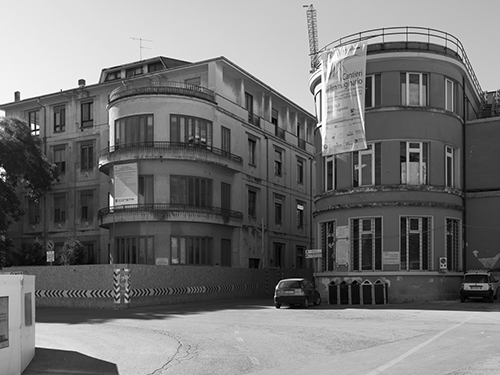
Il progetto fotografico nasce dall’individuazione di un percorso fisico capace di restituire la complessità strutturale del territorio aquilano e di descrivere, allo stesso tempo, la scansione temporale della sua evoluzione, nel tentativo di offrire un’immagine quanto più possibile esaustiva dell’attuale stato del paesaggio locale.
Partendo dalla frazione di Collebrincioni, a nord della conurbazione dell’Aquila, la linea di sezione attraversa un lungo tratto montano per poi scendere e entrare in città attraverso il quartiere Torretta (sorto negli anni Trenta e sviluppatosi fino agli anni Settanta), proseguendo verso la Fortezza Spagnola, che segna l’ingresso nella città murata.
Da qui il percorso attraversa il centro storico fino a raggiungere la Villa, area intra moenia originariamente occupata da orti e, a partire dagli anni Venti, progressivamente edificata con case unifamiliari, fino a saturare negli anni Sessanta la propria capacità insediativa con condomini addossati alle mura, sia all’interno sia all’esterno della cerchia.
Il tracciato prosegue quindi verso la frazione di Roio, attraversando quella di Pianola e mettendo in evidenza, anche in questo caso, la complessità e le criticità del territorio.
L’evento sismico non costituisce il soggetto principale della ricerca, ma è assunto come accadimento temporale all’interno di una cronologia più ampia, un momento che, nella sua tragicità, diventa occasione di riflessione sul paesaggio.
Marco Introini
2017
Chronography of the Territory of L’Aquila
The photographic project originates from the identification of a physical route capable of conveying the structural complexity of the territory of L’Aquila and, at the same time, of tracing the temporal sequence of its evolution, in an attempt to offer an image as exhaustive as possible of the current condition of the local landscape. Starting from the hamlet of Collebrincioni, to the north of the conurbation of L’Aquila, the section line crosses a long mountain stretch before descending and entering the city through the Torretta district (developed from the 1930s and expanded through the 1970s), then continuing towards the Spanish Fortress, which marks the entrance to the walled city.
From there, the route passes through the historic centre until it reaches the area known as the Villa, an intra moenia zone originally occupied by vegetable gardens which, from the 1920s onwards, was gradually built up with single-family houses, eventually reaching full settlement capacity in the 1960s with apartment buildings set against the walls, both inside and outside the perimeter. The route then continues towards the hamlet of Roio, passing through the hamlet of Pianola and, here too, revealing the complexity and critical issues of the territory.
The earthquake is not the main subject of the research; rather, it is considered as a temporal event within a broader chronology, a moment which, in its tragedy, becomes an opportunity for reflection on the landscape.
Marco Introini
2017
Il progetto fotografico nasce dall’individuazione di un percorso fisico capace di restituire la complessità strutturale del territorio aquilano e di descrivere, allo stesso tempo, la scansione temporale della sua evoluzione, nel tentativo di offrire un’immagine quanto più possibile esaustiva dell’attuale stato del paesaggio locale.
Partendo dalla frazione di Collebrincioni, a nord della conurbazione dell’Aquila, la linea di sezione attraversa un lungo tratto montano per poi scendere e entrare in città attraverso il quartiere Torretta (sorto negli anni Trenta e sviluppatosi fino agli anni Settanta), proseguendo verso la Fortezza Spagnola, che segna l’ingresso nella città murata.
Da qui il percorso attraversa il centro storico fino a raggiungere la Villa, area intra moenia originariamente occupata da orti e, a partire dagli anni Venti, progressivamente edificata con case unifamiliari, fino a saturare negli anni Sessanta la propria capacità insediativa con condomini addossati alle mura, sia all’interno sia all’esterno della cerchia.
Il tracciato prosegue quindi verso la frazione di Roio, attraversando quella di Pianola e mettendo in evidenza, anche in questo caso, la complessità e le criticità del territorio.
L’evento sismico non costituisce il soggetto principale della ricerca, ma è assunto come accadimento temporale all’interno di una cronologia più ampia, un momento che, nella sua tragicità, diventa occasione di riflessione sul paesaggio.
Marco Introini
2017
Chronography of the Territory of L’Aquila
The photographic project originates from the identification of a physical route capable of conveying the structural complexity of the territory of L’Aquila and, at the same time, of tracing the temporal sequence of its evolution, in an attempt to offer an image as exhaustive as possible of the current condition of the local landscape. Starting from the hamlet of Collebrincioni, to the north of the conurbation of L’Aquila, the section line crosses a long mountain stretch before descending and entering the city through the Torretta district (developed from the 1930s and expanded through the 1970s), then continuing towards the Spanish Fortress, which marks the entrance to the walled city.
From there, the route passes through the historic centre until it reaches the area known as the Villa, an intra moenia zone originally occupied by vegetable gardens which, from the 1920s onwards, was gradually built up with single-family houses, eventually reaching full settlement capacity in the 1960s with apartment buildings set against the walls, both inside and outside the perimeter. The route then continues towards the hamlet of Roio, passing through the hamlet of Pianola and, here too, revealing the complexity and critical issues of the territory.
The earthquake is not the main subject of the research; rather, it is considered as a temporal event within a broader chronology, a moment which, in its tragedy, becomes an opportunity for reflection on the landscape.
Marco Introini
2017
to photo work